
How Do 400 Million People Disappear?
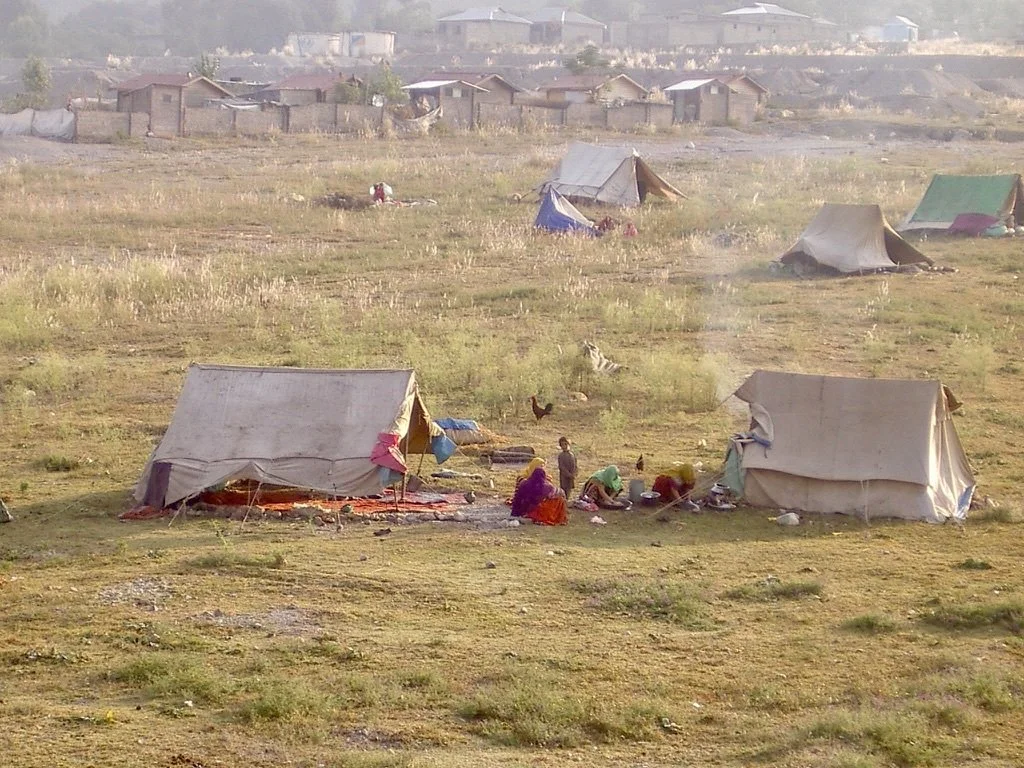
A mobile pastoral community occupies the open land in the foreground while more permanent structures stand behind it. The contrast illustrates a recurring problem in how we see history: settled communities leave durable structures, while the physical traces of mobile communities can quickly disappear after they move on.
They don't.
But we can learn not to see them.
Throughout this series, we've been trying to see differently—to notice mobility where settled eyes may see only instability, to read familiar Scripture within its historical world, and to listen for voices that have too often been forgotten.
In the last few episodes, we met some of those voices. Ancient people moving through the deserts of Arabia scratched prayers and names into stone. Some apparently knew the name of Jesus surprisingly early. And scholars today are learning to hear what they left behind.
But that raises another question.
Why were those voices so easy to miss in the first place?
Some Ways of Life Leave Bigger Ruins
Imagine two communities living in the same region for generations.
One builds walls, houses, temples, administrative buildings and cemeteries. It stores records in archives. Broken pottery accumulates. Buildings collapse and are rebuilt on top of earlier buildings. Eventually the settlement itself becomes a mound.
The other moves.
Its people carry what they need. They repair things. Reuse them. Repurpose them. When something finally becomes useless, there may not be much left to discard.
Their shelters may be made from wood, hair, wool, hides, reeds or other materials that eventually return to the earth. Their most important knowledge may travel in songs, stories, genealogies and memories rather than libraries.
A thousand years later, which community is easier to find?
That sounds almost embarrassingly obvious.
Yet much of what we call "history" depends upon what survives.
Stone survives.
Pottery survives.
City walls survive.
Archives sometimes survive.
Mobility? Not so much.
That doesn't mean mobile peoples weren't there. It means their way of being in a place may leave a different kind of evidence.
And sometimes the problem isn't that the evidence disappeared.
Sometimes we make the mobility disappear ourselves.
We Even Managed to Settle Abraham
Abraham may be one of the most famous human beings who ever lived.
Judaism, Christianity and Islam all remember him. Billions of people know his name.
You would think he would be difficult to lose.
Yet I repeatedly encounter people who insist that Abraham wasn't really a nomad.
Sometimes the reasoning begins with Ur. Abraham came from Ur, they say, and Ur was a great city. Therefore Abraham was essentially an urban person who left one settled place for another.
Except even the identification of Abraham's Ur with the famous southern Mesopotamian city is a question worth examining more carefully.
More importantly, that's not how the biblical story describes Abraham's life after God's call.
He moves.
And he doesn't move alone.
Abram travels with Sarai, Lot, possessions, livestock and the people attached to his household. He moves through the land, pitches his tent, pulls it down and moves again. He negotiates access to land and water. He travels in response to famine. His people and herds and Lot's people and herds become too numerous to remain together, so their communities separate.
He goes south to Egypt.
He comes back.
He moves again.
And these are only the movements that happen to be mentioned.
You don't keep large flocks and herds permanently in corrals and simply truck in feed and pipe in water—not in Abraham's world and not among much of the extensive agro-pastoralism practiced across the Majority World today. Animals move to find pasture and water. The people responsible for them move too.
Even in the land God promises him, Abraham remains mobile.
Later readers sometimes interpret some of that movement—especially the journey to Egypt—as though Abraham has temporarily abandoned the place where God told him to be.
But perhaps that assumption tells us as much about our understanding of place as it does about Abraham's faith.
Hebrews remembers the story differently:
Abraham lived in the land of promise "as in a foreign land," dwelling in tents with Isaac and Jacob.
Three generations.
Still tents.
Still sojourners.
Still waiting.
Abraham had not failed to become stable.
Mobility was his stability.
And yet we can read his biography over and over until somehow the nomad disappears.
How Does That Happen?
Partly because every reader brings assumptions to the text.
Most of us today live in a world organized around settled categories.
We have permanent addresses.
Countries have borders.
Governments conduct censuses.
Children are assigned to school districts.
Property belongs to particular people in particular places.
Maps divide territory into neat administrative units.
Even our language can quietly reinforce the assumption that permanence is normal while movement requires explanation.
Where do you live?
Where are you from?
What is your permanent address?
Which country are you a citizen of?
None of those are bad questions.
But they aren't necessarily the questions around which every human community organizes its life.
When those categories become the grid through which we read history, mobile peoples can become strangely difficult to see.
A pastoral community may appear in someone else's records only when it enters a kingdom, crosses a border, pays a tax, raids a settlement, trades in a market or causes trouble for an administrator.
The settled society produces the archive.
So the settled society often gets to describe the people moving around it.
And eventually someone writes the history from the archive.
The Bible Is a Nomadic Book
This is one reason I increasingly describe the Bible as a nomadic book.
That may sound strange.
Nomads aren't generally famous for building libraries.
Books are heavy. Scrolls are cumbersome. Stone tablets are even worse.
People who move learn to be selective about what they carry. Things are used, repaired, reused and repurposed. Objects carried from place to place wear out.
Long-term preservation usually requires something quite different: putting an object somewhere protected and leaving it there.
And yet the biblical story is saturated with mobility.
Abraham and Sarah.
Isaac and Rebekah.
Jacob and his household.
Joseph carried into Egypt.
And even Egypt doesn't erase the pastoral story as completely as we sometimes imagine.
When Jacob's household arrives, Pharaoh gives them land in Goshen precisely in the context of their livestock and their identity as shepherds. Generations later, when Israel leaves Egypt, they don't walk out as a population that has completely forgotten livestock and pastoral life. Exodus specifically tells us that "large droves of livestock, both flocks and herds" went with them.
We can spend so much time imagining Hebrew slaves making bricks that we forget to notice the sheep walking out of Egypt with them.
Then comes the wilderness.
Forty years of movement—but hardly the first time God's people had moved.
Pastoralists. Shepherds. Refugees. Exiles. Traders. Pilgrims. Travelling teachers.
Movement keeps appearing.
Jesus himself moves continually through the landscape of Galilee and Judea with a community of followers.
Years ago, after watching the JESUS film for the first time in their own language, one nomadic viewer exclaimed in recognition:
"Jesus and his followers are just like us!"
Perhaps he noticed something that settled readers have learned not to see.
After Jesus, Paul and his companions carry the Good News along roads, sea lanes and trading networks throughout the Roman world.
And the movement doesn't stop at Rome's borders.
Other followers carry the story east and south—into Persian and Arab worlds, across North Africa, through Central Asia and eventually far toward India and beyond.
The Bible doesn't merely contain people who move.
Again and again, movement is part of how the story moves.
Perhaps the surprising thing isn't that nomads are difficult to find in history.
Perhaps the surprising thing is how easily we can stop seeing mobility even when it is right in front of us.
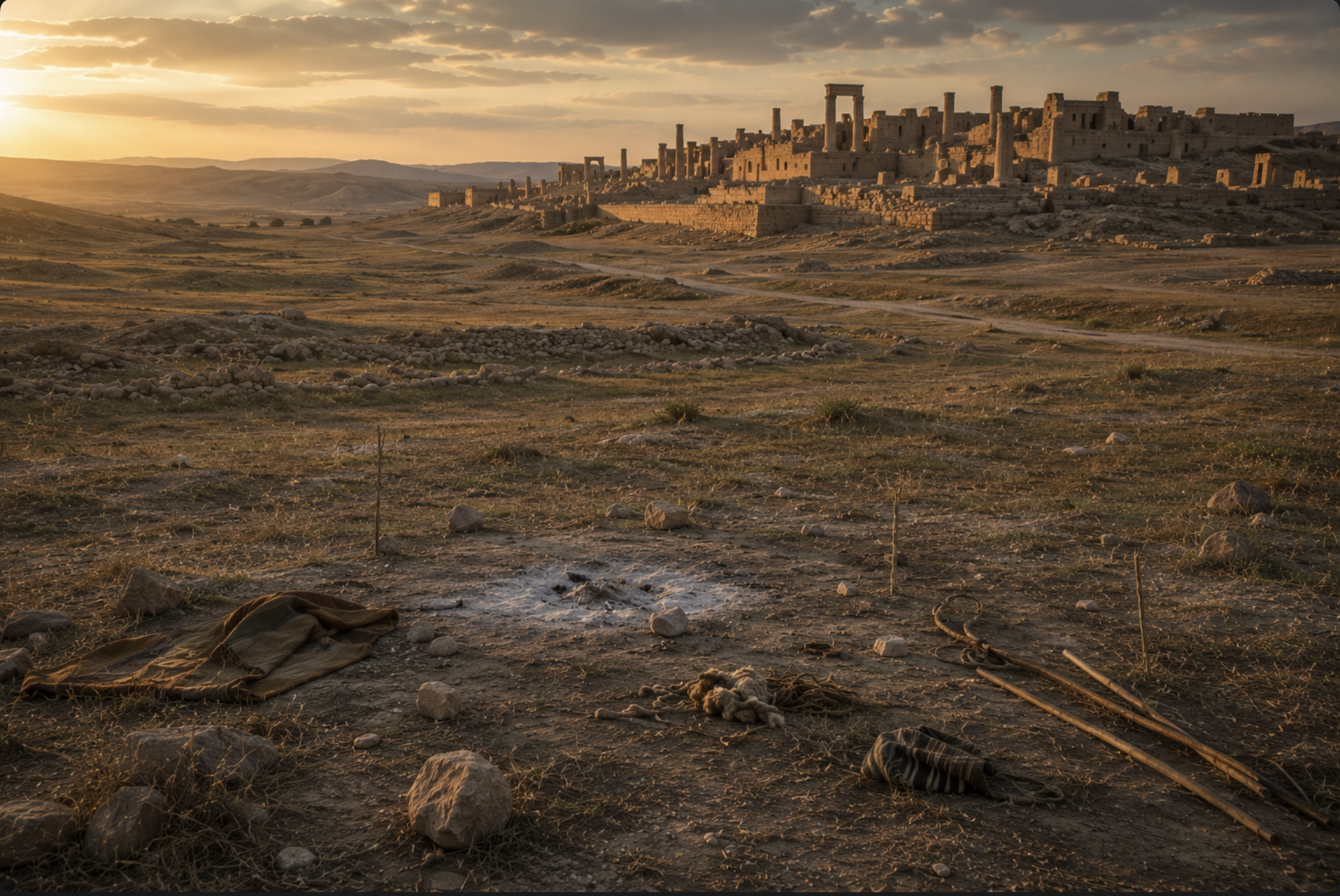
An imagined contrast between two kinds of historical footprint. Monumental settlements may remain visible for centuries, while a pastoral campsite can leave little more than a hearth, disturbed ground, stakes and scattered organic materials. Absence of ruins is not evidence of absence.
The Gap May Be in Our Vision
That's why recovering forgotten voices matters.
But it also means we need to ask a harder question.
What if some mobile peoples haven't actually disappeared from history?
What if we've simply learned to look for human communities in ways that make them difficult to recognize?
If we expect important people to build permanent monuments, we will find monument builders.
If we expect societies to occupy clearly bounded territories, we will find territorial societies.
If we expect peoples to fit neatly inside countries, languages and census categories, we will find the people who fit those categories.
And those who don't?
They can become surprisingly invisible.
Even Abraham.
Which brings us to an uncomfortable possibility.
The problem isn't only ancient history.
We are still counting people.
Still drawing maps.
Still defining people groups.
Still deciding who belongs where.
And mobile peoples are still crossing the lines we draw.
What if some of the gaps on our maps aren't empty at all?
That's where we'll go next.