
Did Nomads Follow Jesus Before They Built Churches?
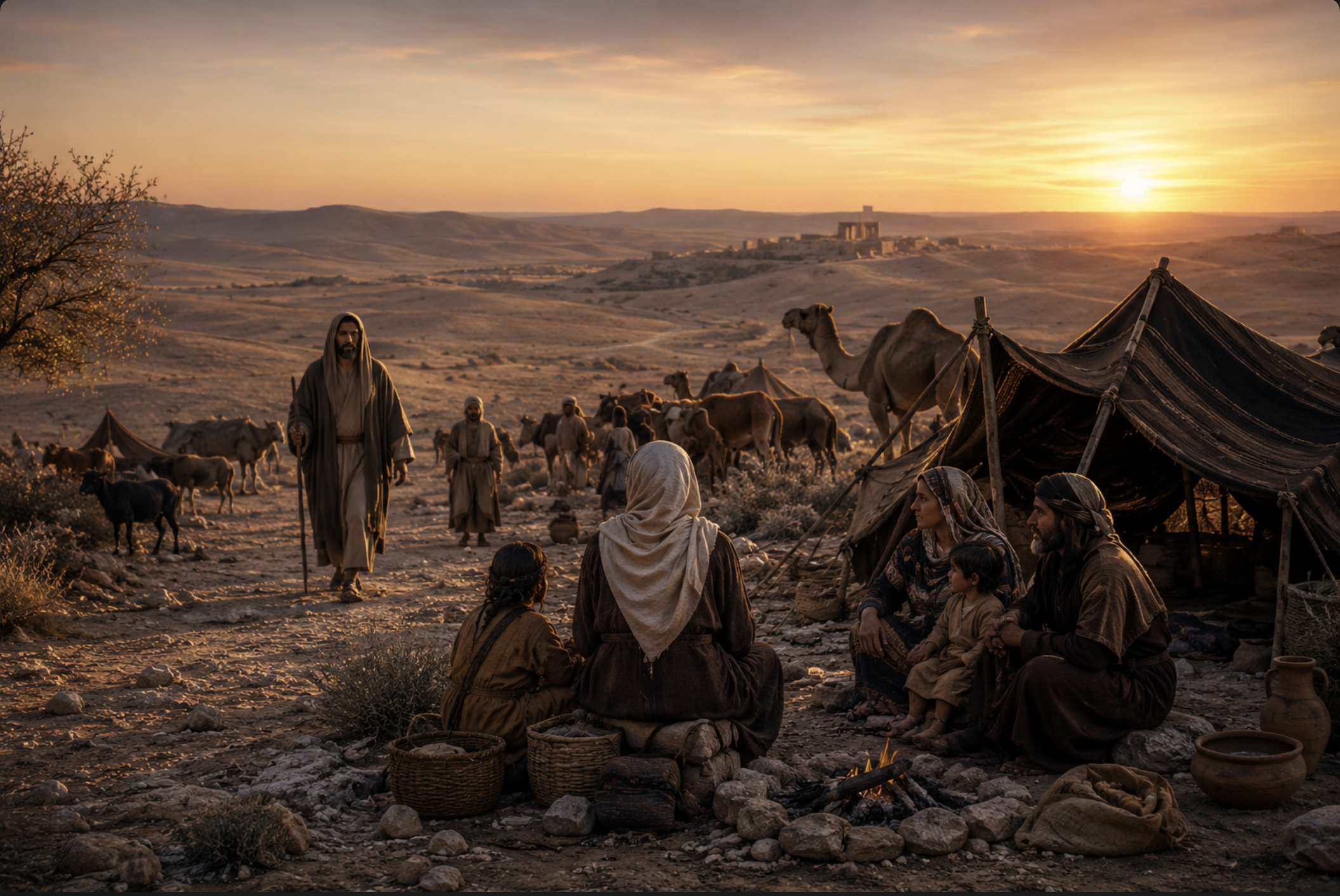
An artistic representation of a late-antique Arabian nomadic community at the desert frontier. Families gather beside their tents and animals as a traveler approaches, evoking the encounters between mobile Arab peoples and followers of Jesus described in fourth-century sources. Image generated with AI; not a depiction of a specific historical event or person.
Imagine arriving at the edge of a desert in the fourth century.
There is no church building.
No denominational sign.
No Sunday bulletin.
No theological college.
No mission compound.
Perhaps not even a permanent settlement.
But somewhere beyond the cultivated land are families moving with animals, following water, pasture, trade routes, kinship ties and seasons.
And some of them are encountering Jesus.
That possibility should not surprise us.
And yet, if our mental picture of early Christianity is built primarily around bishops, councils, basilicas, monasteries and cities, it can be surprisingly difficult to see.
The problem is familiar.
Settled people tend to leave settled records.
Cities leave buildings.
Institutions leave archives.
Bishops leave letters.
Councils leave creeds.
Monasteries preserve manuscripts.
Nomads leave different kinds of evidence—and sometimes very little that historians trained to look for institutions know how to recognize.
In our last episode, "When Nomads Wrote the Name of Jesus in the Desert", we encountered something unusually precious: words apparently left by the nomads themselves. Ahmad Al-Jallad's work among the Safaitic inscriptions of the Arabian desert has helped recover prayers, grief, names, genealogies and glimpses of the religious world of people who might otherwise remain almost silent in our histories.
One remarkable inscription, probably dating to around the fourth century, appears to invoke Jesus.
But that inscription raises an even bigger question.
What was happening when the story of Jesus began moving through the nomadic worlds beyond the cities?
First, a warning about the word “Saracen”
If we follow the written sources into the deserts of Late Antiquity, we quickly encounter a word that appears again and again:
Saracens.
Greco-Roman and Christian writers used the term for various Arab peoples associated especially with desert and steppe regions. We should resist imagining that “the Saracens” were one clearly defined ethnic nation.
They weren't.
The label could encompass different tribes, alliances and mobile populations living between and alongside the Roman and Persian worlds.
And there is another problem.
Most of the surviving descriptions were written by settled outsiders.
Anthony Sattin makes this problem an important part of the opening argument of his book Nomads: The Wanderers Who Shaped Our World. Much of the history we have inherited was written in cities and settled civilizations. Nomadic peoples therefore frequently enter the written record through the eyes—and prejudices—of the people looking outward at them.
Those writers could portray desert peoples as wild, violent, uncivilized, pagan and dangerous.
Sound familiar?
The stereotype of the dangerous nomad has a very long history.
That means we have to read these accounts carefully. They may preserve valuable information about encounters between nomadic peoples and Christians while simultaneously telling us quite a lot about the prejudices of the people doing the writing.
The nomads themselves are often the people whose voices we hear least.
But every so often, something breaks through.
A desert people asks for a shepherd
One of the most remarkable stories comes from the fourth century.
Early Christian historians tell us of an Arab queen commonly known as Mavia or Māwiyya, who led Saracen forces in revolt against Rome around AD 378.
This was no insignificant desert skirmish.
Her forces challenged Roman power across parts of Arabia and Palestine, and Rome eventually sought peace.
According to the early Christian historians who preserve the story, Mavia had a remarkable condition.
She wanted a particular man named Moses appointed as bishop for her people.
And this is where the story gets even better.
Moses wasn't a Roman missionary dispatched into the desert.
The fifth-century historian Socrates Scholasticus describes him as "a Saracen by birth"—a man from this desert world himself, who was already living a monastic life in the wilderness and had become known for his faith and character.
Mavia wanted him to shepherd her people.
And she apparently wanted him badly enough to make his appointment a condition of peace with Rome.
The Roman authorities agreed.
But Moses wasn't about to become Rome's compliant desert bishop.
When he was taken to Alexandria to be consecrated, the powerful bishop Lucius prepared to ordain him. Moses refused.
Lucius had been involved in bitter persecution during the theological conflicts dividing Christians at the time. Moses objected not only to his theology but to his conduct toward other followers of Jesus.
Other bishops eventually ordained Moses.
He then returned to serve among Mavia's people, and the peace was concluded.
You can read Socrates' account of Mavia and Moses here, in Book IV, chapter 36. A somewhat fuller version appears in Sozomen's Ecclesiastical History.
Of course, these writers had their own theological agendas, and the accounts come to us through Christian historians rather than Mavia or Moses themselves.
But something extraordinary remains.
Here is an Arab tribal confederation negotiating with the Roman Empire, and their choice of spiritual leader matters enough to become part of the peace agreement.
And that leader is himself identified as a Saracen.
Christianity was not merely leaking outward from a city into a few isolated desert converts.
Something was happening at the level of a people.
A network.
Leadership.
Community.
Belonging.
And apparently a desert people could recognize one of their own as the person they wanted to shepherd them.
That should make us look again.
Jesus at the edge of the desert
Other stories take us into the region around Gaza and the Negev.
Jerome, writing his Life of Hilarion near the end of the fourth century, tells of the famous ascetic Hilarion and his encounters with people whom Jerome calls Saracens.
One episode places Hilarion near Elusa, an important town on the desert frontier.

Ruins of ancient Elusa (Haluza) in the Negev. Jerome places Hilarion’s encounter with Saracen families at this important desert-frontier city. Photo: Bukvoed, CC BY 3.0, via Wikimedia Commons.
Jerome describes Saracens gathering there for an annual festival connected with the goddess Venus. When they heard that Hilarion was passing through, they came to meet him.
And Jerome gives us a detail worth noticing.
They came with their wives and children.
You can read Jerome's Life of Hilarion here.
Jerome tells the encounter as a dramatic Christian conversion story.
We need to read it with appropriate caution.
Ancient biographies of holy men were not modern journalism. Their purpose was theological and devotional, and Jerome clearly wanted his readers to see the spiritual power of Hilarion.
But notice who appears in the story.
Families.
Communities.
Desert peoples moving between their own social world and a regional gathering place.
They are not invisible.
They are interacting with Christian teachers and ideas.
And by the fourth century, encounters between Christian monks, settlements and surrounding nomadic peoples were occurring across the desert margins of the Roman East.
Sometimes those encounters were peaceful.
Sometimes they were violent.
Sometimes Christian writers portrayed the nomads terribly.
Sometimes Arab leaders became deeply involved in the theological and political struggles of the Roman world.
The picture is messy.
Real history usually is.
But it becomes increasingly difficult to maintain a simple picture in which Christianity belonged to settled cities while pagan nomads remained somewhere outside the story.
What would following Jesus have looked like?
This is where I become particularly curious.
Suppose an Arab pastoral family in the fourth or fifth century came to trust Jesus.
Then what?
Did they immediately stop moving?
Build a church?
Adopt the worship patterns of a nearby Roman town?
Restructure their community around a resident clergyman?
Perhaps sometimes.
But we should be careful not to read later Christian institutions backward into every early encounter with Jesus.
A mobile community already had places where life happened.
Tents.
Campfires.
Seasonal gathering places.
Wells.
Pastures.
Markets.
Kinship networks.
Hospitality.
Poetry and oral memory.
Leaders whose authority did not depend upon an office in a building.
News could move through those networks because people moved through those networks.
We've explored this before in asking whether monasteries preserved the message while nomads carried it. The point isn't to romanticize nomadic mobility or claim that we can reconstruct exactly how every community communicated the Good News.
We can't.
But we can ask a different historical question.
Instead of:
Where was their church?
Perhaps we should first ask:
Where was their community?
That question may reveal things our settled categories miss.
A people can follow Jesus without becoming somebody else first
This isn't merely an interesting question about Late Antiquity.
It reaches directly into the way we think about nomadic peoples today.
When the Good News crosses a cultural boundary, Christians have often carried more than the Good News with us.
We carry assumptions about buildings.
Leadership.
Education.
Worship.
Decision-making.
Membership.
Time.
Money.
Family.
Even what a person who follows Jesus is supposed to look like.
Sometimes those things are biblical.
Sometimes they are simply familiar.
And the two can be remarkably easy to confuse.
We've already asked why "church" can sometimes sound like bad news when following Jesus appears to require leaving one's people and joining somebody else's religious community.
The fourth-century desert should at least make us wonder whether that problem is much older than modern missions.
What happens when the Good Shepherd encounters a people whose life is organized around movement, family and clan?
Does He require them to become settled before He can shepherd them?
Surely not.
The story gets even bigger
By the fifth and sixth centuries, Arab involvement in Christianity becomes impossible to treat as peripheral.
Arab tribal elites supported different Christian theological movements.
Arab federations became important allies of the great empires.
Monks and nomads encountered one another throughout the desert margins.
Christianity took root in parts of Arabia itself.
And Arab Christian communities became significant participants in the religious and political world in the centuries immediately before the rise of Islam.
This doesn't mean Arabia simply became Christian.
Far from it.
Traditional Arabian religions remained important. Jewish communities and influence were significant. Christianity itself took different forms in different regions. Political alliances and theological loyalties overlapped in complicated ways.
There was no single "Arab Christianity."
There wasn't even a single "Arab" social world.
But there were clearly Arab followers of Jesus.
And among the peoples described in our sources were communities with strong pastoral and nomadic identities.
That matters.
Because when we tell the story of Christianity primarily through Rome, Constantinople, Alexandria, Antioch and Jerusalem, it is easy to imagine the desert as empty space between important places.
It wasn't.
People lived there.
People moved through it.
People carried news through it.
People argued theology in it.
People prayed in it.
And some of them followed Jesus in it.
Maybe the building is the wrong place to start
None of this means buildings are bad.
Some early Christians built them.
Nomadic Christians have built them—oddly enough, even in places like the Sahara!
Settled places can become enormously important gathering points for mobile peoples.
The problem comes when the building becomes our definition of whether Christian community exists.
The same is true of our other familiar structures.
If we begin with the structure, we may spend our energy trying to move people into it.
If we begin with the people, we can ask a better question:
How might this community follow the Shepherd together?
For a nomadic people, that may involve forms of gathering, leadership, teaching and belonging that move.
For a community now living in a city but carrying a nomadic heritage, kinship networks may still matter more than geographic neighborhoods.
For refugees or immigrants scattered across several countries, the meaningful community may stretch across borders and communicate constantly through phones, travel, weddings, funerals and family obligations.
The camel caravan may disappear while the network remains.
And perhaps the fourth-century desert has something to teach us about that.
Listen for the voices beyond the walls
There is an irony in studying early Christianity.
Much of what survived survived because somebody eventually put it inside a building.
Libraries.
Monasteries.
Churches.
Archives.
That preservation is an extraordinary gift.
But it can also shape what we imagine the past looked like.
If nearly all the voices we hear come from inside the walls, we may unconsciously assume that most of the important things were happening there.
They weren't.
Beyond the walls were shepherds.
Traders.
Families.
Tribes.
Migrants.
Refugees.
Travelers.
People moving between empires.
People whose names never appeared in an ecclesiastical history.
And apparently, surprisingly early, some of them were encountering Jesus.
Perhaps some were even discovering that the Good Shepherd knew how to walk their trails.
So when we ask whether nomads followed Jesus before they built churches, we may be asking the question backward.
Maybe the more interesting question is:
Why would we expect the Shepherd to wait for a building?