
When Nomads Wrote the Name of Jesus in the Desert
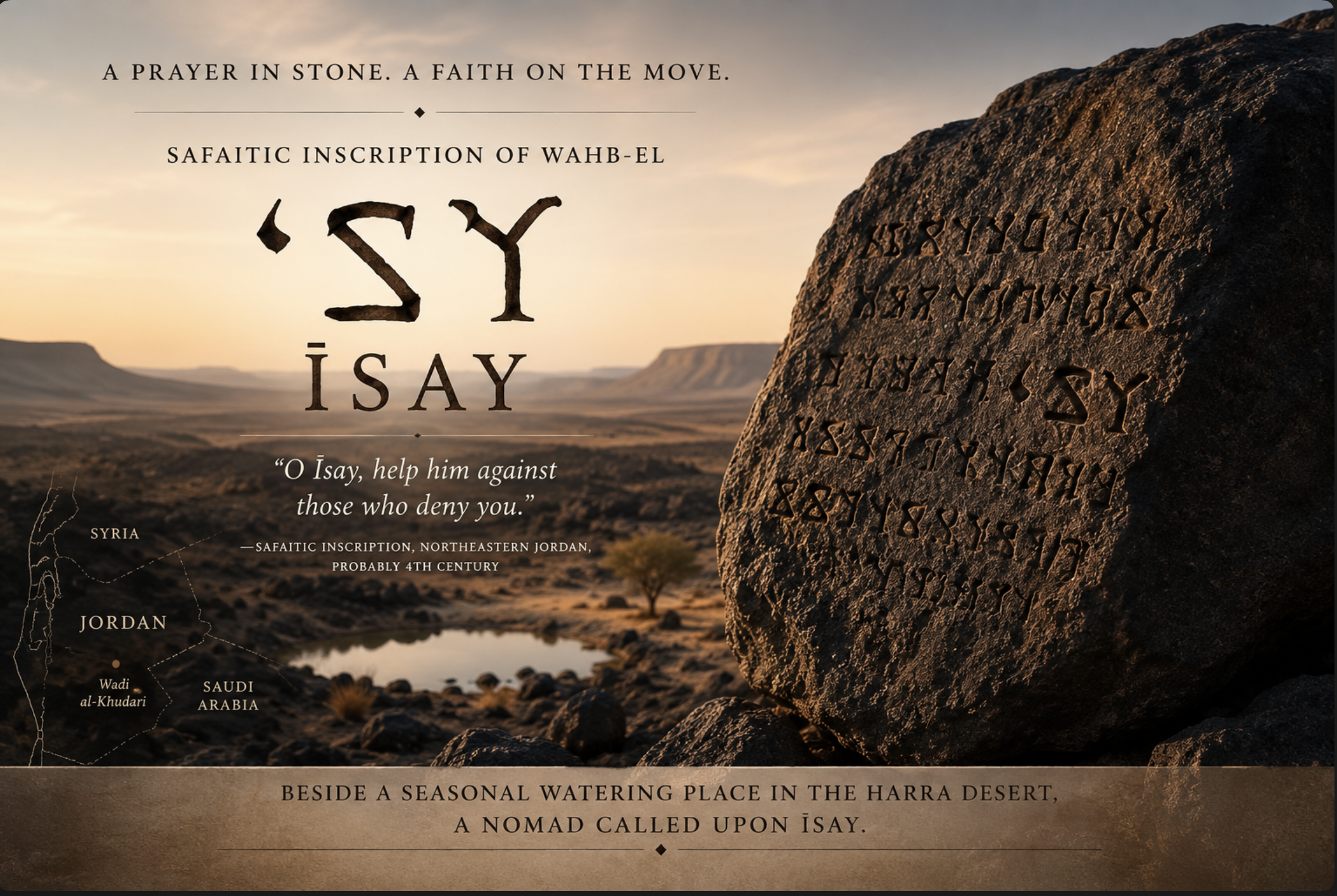
Somewhere in the black volcanic desert of northeastern Jordan, perhaps around the fourth century, a man named Wahb-El stopped beside a seasonal watering place. of northeastern Jordan, perhaps around the fourth century, a man named Wahb-El and his kafila clan caravan, stopped beside a seasonal watering place.
He belonged to a world of pastoral nomads—people who hunted, herded livestock, raised camels, and moved through the vast volcanic landscape known as the Harra. And like thousands of others who traveled these lands, Wahb-El knew how to write.
He picked up a tool and scratched words into a rock.
His name.
His genealogy—nine generations of it.
His grief for his maternal uncle, a member of the Ashlal tribe.
And then a prayer:
“O Īsay, help him against those who deny you.”
Īsay.
Could Wahb-El have been calling upon Jesus?
If Arabic epigrapher Ahmad Al-Jallad's interpretation is correct, this weathered piece of desert graffiti may preserve the earliest known reference to Jesus from within Arabia itself.
And it wasn't written in a cathedral.
It wasn't copied in a monastery.
It wasn't issued by a bishop.
A nomad scratched it onto a rock beside a desert watering place.
The Desert Has an Archive
We tend to reconstruct the history of Christianity from the things settled people leave behind.
Churches. Monasteries. Libraries. Cities. Bishops. Councils.
But what happens when the people following Jesus are mobile?
Nomads leave a different archaeological footprint.
The Harra stretches from southern Syria across northeastern Jordan and into northern Saudi Arabia. Its summers are brutally hot, its winters cold, and rainfall scarce. Yet this seemingly empty landscape has been home to pastoral nomads for millennia.
And they left an extraordinary archive.
By around the turn of the Common Era, nomads of the Harra had mastered a local writing tradition. They carved tens of thousands of inscriptions in an early dialect of Arabic using an indigenous alphabet scholars call Safaitic.
Some contain prayers, curses, sacrifices, and appeals for protection. Many simply record a person's name: I was here.
Others remember the dead.
They tell us about drought, journeys, enemies, livestock, family and grief.
These aren't official histories written by kings.
They are voices from the desert.
A Rock Beside a Watering Place
To an unfamiliar eye, the landscape can look almost uninhabitable: mile after mile of broken black volcanic rock, baking beneath the desert sun. But pastoralists knew this country differently—where seasonal water collected, where grazing appeared after rain, and how to move animals through terrain outsiders might see only as barren.
One of those places was Wadi al-Khudari.
In 2019, Al-Jallad and Jordanian scholar Ali Al-Manaser were conducting an epigraphic survey in a remote part of the Harra called Wadi al-Khudari.
They followed a small footpath toward a dry seasonal lake.
There they found a small human-made pile of stones—a cairn— covered with more than a hundred inscriptions. Some described watering animals and conditions of drought. Al-Jallad suggests this may have been one of the last places where water remained during the dry season.
It isn't difficult to imagine the scene.
Animals gathered around precious water. People waiting. Talking. Resting.
And some passing the time by carving words into stone.
Among those inscriptions was Wahb-El's.
At first it looks much like other Safaitic texts.
But its final prayer is different.
The word ʿsy—which Al-Jallad suggests was perhaps pronounced Īsay—appears after the normal Safaitic particle used when addressing a deity. The spelling also corresponds to the Arabic name for Jesus familiar from the Qur'an: ʿĪsā.
Then there is the vocabulary of the prayer itself.
Wahb-El asks Īsay to help him against those who deny him. Al-Jallad notes that this language is virtually unattested in other Safaitic prayers but fits naturally within Christian vocabulary, where denial of Christ carries particular significance.
None of this makes the interpretation certain. The inscription is undated, and Al-Jallad himself concludes that identifying it as the earliest witness to Arabian Christianity must remain a “tantalizing possibility” until further evidence appears.
But if he is right, Wahb-El gives us an extraordinary glimpse of Jesus entering a nomadic world.
Not Just a Borrowed Name
There is another fascinating possibility hidden in that little word Īsay.
How did Yeshua, the Hebrew-Aramaic name of Jesus, eventually become Arabic ʿĪsā?
It is tempting to imagine names moving between languages primarily by transliteration: hear a foreign name, then reproduce its sounds as closely as the receiving language allows.
Al-Jallad proposes something more interesting.
Īsay was already an Arabian personal name. Safaitic inscriptions use it for people who were clearly pagan; one example identifies a man as “Qadam son of Īsay” and then invokes the Arabian god Roḍaw.
So why might this existing Arabian name have become associated with Jesus?
Al-Jallad proposes a process called phonosemantic matching—adopting a word by associating it with something in the receiving language that resembles it in both sound and meaning.
His suggestion is striking: the name Yeshua may have been matched with “a pre-existing Arabic name Īsay, which likely meant ‘ransomer’ or ‘redeemer.’” The underlying Arabian root carried the idea of purchasing or acquiring, giving the name a semantic connection with ransom and redemption.
If Al-Jallad is right, these desert Arabs did not simply receive a foreign religious name and approximate its pronunciation.
They found something already present in their own language that could carry it.
Not merely adoption.
Adaptation.
Not merely transliteration.
Translation.
And that makes what happens in Wahb-El's inscription even more interesting.
The New Grafted Onto the Old
Al-Jallad describes the inscription itself as an example of “the grafting of the new upon the old.”
Wahb-El did not invent a new Christian writing system.
He did not abandon his people's Safaitic literary tradition.
He wrote the sort of inscription desert people around him had been writing for generations: name, genealogy, remembrance, prayer.
But something at the center had changed.
The old gods normally invoked in such prayers were gone.
Wahb-El called upon Īsay.
Al-Jallad suggests that Wahb-El may have been a convert who adapted his existing Safaitic writing tradition to express his new faith.
We shouldn't make Wahb-El into more than the evidence allows. One inscription cannot tell us everything he or his people understood about Jesus. Nor should we imagine him as an isolated individual making a solitary spiritual journey. Wahb-El identifies himself through nine generations of genealogy and remembers his maternal uncle by tribal affiliation. Whatever was happening here, he understood himself within a web of kinship.
The rock gives us one voice. It does not tell us how many others shared his prayer.
But it does allow us to glimpse something remarkable about what can happen when the Good News crosses a cultural boundary.
But that uncertainty is part of what makes the inscription valuable.
We are watching, perhaps, one of those messy moments when the Good News crosses a cultural boundary.
Wahb-El apparently remained a man of the Harra.
His language remained his language.
His genealogy still mattered.
His people's way of writing remained useful.
But now, when he needed help, he called upon someone else.
Īsay.
How Did Jesus Reach the Harra?
We don't know.
Perhaps Wahb-El encountered followers of Jesus while visiting settled communities. Safaitic inscriptions demonstrate contacts with places such as Bostra in Syria and cities of the Decapolis.
Perhaps missionaries deliberately ventured into the desert.
Al-Jallad notes isolated Greek graffiti scattered through the Harra, some clearly Christian, and wonders whether these might preserve traces of ancient missionaries who preached among Safaitic-writing nomads.
For now, he says, the circumstances remain unclear.
But perhaps our modern maps make the mystery seem greater than it was.
A desert that looks empty to settled people is not necessarily empty to nomads.
Watering places connect to pastures.
Pastures connect to camps.
Camps connect to clans.
Clans connect through marriage, trade, hospitality, pilgrimage, conflict and kinship.
And stories travel along those same networks.
Perhaps the better question isn't simply, How did Christianity penetrate such a remote place?
Perhaps we should also ask:
How did news move through the networks that were already there?
Paul Went to “Arabia” Too
There is an intriguing geographical echo here—although we should resist making more of it than the evidence permits.
Several centuries before Wahb-El probably scratched his prayer into the rock, Paul wrote something tantalizing about the period immediately following his encounter with Jesus:
“I went away into Arabia, and returned again to Damascus.”
—Galatians 1:17
Paul's “Arabia” should not simply be equated with the borders of modern Saudi Arabia. In his first-century world, Arabia included the Nabataean territories east and south of Judea, adjoining the Syrian and Transjordanian landscapes through which Arabian pastoral peoples moved.
Paul tells us almost nothing about what he did there.
We certainly cannot draw a historical line from Paul to Wahb-El. We don't know that they walked the same ground, much less that Paul's mysterious journey had anything to do with the faith reflected centuries later in this inscription.
But his brief comment is a useful reminder.
Arabia was already there in the New Testament story.
Beyond and between the cities were mobile peoples whose histories are much harder for us to see.
Perhaps someday we'll devote an entire post to the question:
Why did Paul go to Arabia?
For now, Wahb-El is waiting for us beside his watering place.
Jesus in Arabia
Wahb-El's inscription is not our only evidence.
By the fifth and sixth centuries, the material evidence becomes clearer. A Saudi-French expedition discovered Arabic inscriptions north of Najran bearing crosses that Al-Jallad describes as unmistakable expressions of Christian identity. A Christian inscription from Dumat al-Jandal, an important North Arabian caravan city, dates specifically to 548/549 C.E.
By the sixth century Christianity appears to have been firmly established in parts of Arabia, including Najran far to the south. And by the seventh century, the Qur'an itself repeatedly engages with Christian beliefs and communities in Arabia. Jesus—ʿĪsā—is one of its most frequently mentioned biblical figures.
We should not turn these scattered pieces into a continuous history that our evidence cannot support.
Paul's Arabia.
Wahb-El's prayer.
The crosses near Najran.
Dumat al-Jandal.
The Christians encountered in the world of the Qur'an.
They are not demonstrated links in a single chain.
They are windows.
And through one of the earliest of those windows we may be looking at a nomadic pastoralist grieving for his uncle and asking Jesus for help.
Maybe We've Been Looking for the Wrong Things
There is a larger lesson here.
When we ask whether nomadic peoples have encountered Jesus, we can unconsciously look for sedentary evidence.
Where is their church?
Where is their building?
Where is their institution?
Where is their theological literature?
Those aren't bad questions.
They just aren't the only questions.
Wahb-El reminds us to look for other things.
Listen to the language.
Follow the kinship networks.
Look beside the watering places.
Pay attention to what people retain, what they adapt, and what changes when Jesus enters their world.
Nearly two thousand years later, those are still good questions when the Good News moves among nomadic peoples.
Maybe our task is not to make nomads settle—culturally or physically—before Jesus can be at home among them.
Maybe we should become better at recognizing what Wahb-El's little prayer may already have been showing us centuries ago:
Jesus can meet people on the move.
And sometimes the evidence is still there—
scratched into a rock in the desert.
—————————————————————
Explore Further
This post draws primarily from Ahmad Al-Jallad, “Jesus in Arabia: Tracing the Spread of Christianity into the Desert,” Biblical Archaeology Review 48.1 (2022): 40–46. Al-Jallad is Professor of Arabic Studies at The Ohio State University and specializes in the languages and writing systems of pre-Islamic Arabia and the ancient Near East. The full article is available through the BAS Library (subscription required).
Al-Jallad's article in the BAS Library
For an even deeper dive: Ahmad Al-Jallad and Ali Al-Manaser, “The Pre-Islamic Divine Name ʿsy and the Background of the Qurʾānic Jesus,” Journal of the International Qur’anic Studies Association 6.1 (2021): 107–136. This is the full scholarly treatment of the Wahb-El inscription. (subscription required).