
The Biblical Story Is a Nomadic Story (and We Forgot)
What if the Bible wasn’t written primarily for people who stay put…
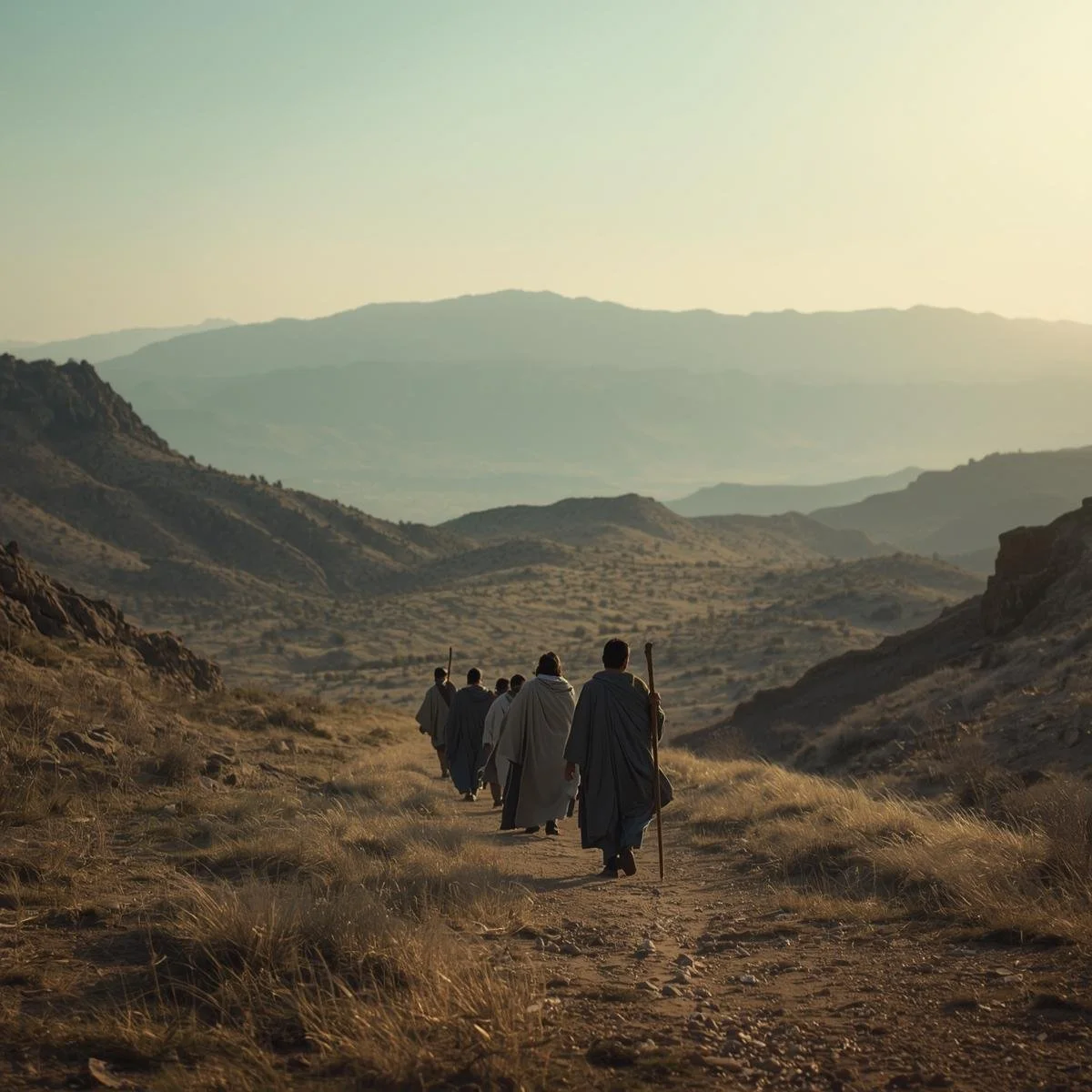
but for people who move? What if Scripture wasn’t shaped around buildings, institutions, or permanent locations—but around journeys, tents, paths, exile, return, and shared movement?
That’s the question I want to explore with you today.
The Bible is not a sedentary book about a religion in a building. It is a nomadic story about a people on the move, following a God who leads them. And if that’s true, then the way many of us read the Bible today—especially in Western, settled contexts—will inevitably distort its meaning.
Not because we’re bad people. Not because we don’t love God. But because we’re reading a mobile story through sedentary eyes.
And this matters not just for anthropology or history, but for how we experience faith, identity, community, discipleship, and belonging right now.
⸻
Movement Is Not Background — It’s the Method
Let me say this simply:
Movement is not a background detail in Scripture. Mobility is how God teaches, forms, and preserves His people.
God doesn’t form identity through comfort. He forms identity through journey. Belonging doesn’t happen in a chair. It happens on the road.
When you trace the biblical story honestly, movement isn’t a side note—it is the method. And once you see that, you start noticing it everywhere.
⸻
Scripture as a Nomad Narrative
Genesis: Covenant on the Move
The Bible begins not with a city, but with a garden… and then exile. After the fall, Adam and Eve are sent out. The first human experience after Eden is displacement.
Then we meet Abraham. God doesn’t say, “Improve your hometown.” He says, “Leave your father’s household. Go to a land I will show you.”
That’s not spiritual metaphor. That’s pastoral-nomadic reality. Abraham moves with his household, his flocks, his kin. And Lot moves with him, as one under Abram’s household—until pastoral pressure forces a separation. Wells, grazing land, conflict resolution: this is nomadic life.
When God makes a covenant, it’s not in a temple, but under the open sky. And notice this: God calls a family—an extended family—not just an individual. Identity is collective. Movement is shared.
⸻
Exodus: Mobility as God’s Strategy for Education
Israel doesn’t learn who they are in Egypt. They learn it on the road.
Forty years of wilderness wandering isn’t punishment—it’s formation. They live in tents. They eat manna (daily dependence). They follow a mobile God. The tabernacle, a tent complex, moves. The presence of God moves.
Israel did not learn theology by sitting in a classroom. They learned it by walking together. Every step taught trust. Every campfire shaped memory.
⸻
David: Shepherd Before King
Before David was a king, he was a shepherd. Before the throne, there were hills, flocks, caves, exile, and pursuit. David lived as a fugitive, a refugee, an asylum-seeker.
God chose a shepherd-king who understood movement and vulnerability—not a palace-trained administrator of stability. Even the Psalms sound nomadic when you hear them right: prayers for the pathway, prayers for survival, shepherd songs.
⸻
Prophets and Exile: When Movement Returns
When Israel forgets movement, God puts them back on the road. Exile is traumatic, but it’s also revelatory. Identity has to be renegotiated. Faith has to survive without land, temple, or monarchy.
And somehow… God is still present.
⸻
Jesus: The Ultimate Nomad Rabbi
Jesus doesn’t settle. He has no property, no headquarters, no permanent base. He walks—village to village, house to house.
He doesn’t say, “Attend my class.” He says, “Follow me.”
The disciples didn’t sign up for a weekly service. They signed up for a road trip that changed everything. Discipleship was embodied—relational, mobile.
⸻
The Early Church: Movement as Mission
Christianity spreads because it moves. Persecution scatters believers. Hospitality networks carry the message. House churches adapt fluidly. The Good News travels with people.
And here’s a crucial pivot: Christianity spreads fastest among mobile peoples. When it settles into territorial institutions, it becomes something very different.
⸻
Why Mobility Matters Theologically
Here are three core reasons mobility matters so much in Scripture—and in discipleship.
1) Mobility Builds Identity
We discover who we are in motion—not in isolation, but as a collective. Stories emerge on the road. Character forms under pressure.
2) Mobility Builds Belonging
Shared risk. Shared labor. Shared memory. Communities are formed not by attending the same event, but by traveling the same path.
3) Mobility Structures Knowledge
Nomadic knowledge is embodied, narrative, and relational. You learn by watching, imitating, telling stories—very different from abstract, individualized, information-centric faith.
⸻
The Cost of Sedentary Faith
Let me be clear: I’m not attacking Western Christians. I’m critiquing a cultural form.
Sedentary theology can drift toward belief over belonging, and content over companionship. Sedentary ecclesiology often centers buildings, programs, and passive audiences.
And when faith stops moving, discipleship becomes a product, not a pilgrimage—not a life walk.
⸻
A Story of Affliction and Shared Belonging Among Himalayan Shepherds
I want to share a personal story—one that shaped my understanding of grief, belonging, and kinship among Himalayan shepherds.
One of the early words I learned from shepherds was their word for affliction: mosibat.
I asked an elder shepherd man, “Sir, give me a story about your life. I’m going to record it to help me learn your language and something about your lives.” He thought for a moment, looked up with a wistful gaze, and said:
“Mosibat. Affliction. Affliction. That is the title of our lives.”
Then he described their life under open skies—tents, grass huts, mud-and-stone shelters—living exposed to heat, cold, storms, and the hard realities of a politically contested region. He told stories of being stopped by armed groups, punished, pushed around, crossing high ridges where oxygen is low, building bridges over rivers, losing animals in torrents, and enduring out-of-season snow and sleet that kills flocks.
“One difficulty after another,” he said—injuries far from medical care, suffering along the path.
That same season, we kept hearing more grief. A bus had taken a wrong turn along the Himalayan ridges and plunged into a ravine, killing forty people—many shepherd relatives trying to regroup for migration. We met person after person who had lost family on that bus.
Then I met a man about my age. He looked remarkably like me—lighter hair, hazel-green-blue eyes, similar beard. But he had sadness in his eyes. He admired my five-year-old daughter and asked her age. When I said “five,” he replied:
“My daughter was five. She was on that bus. And now my mother and my daughter… they are no more.”
We went home shaken. We prayed: How can we identify with people who have so much affliction? How do we enter into their suffering when we—coming from the West—haven’t known suffering like this?
And then the next day, our own world broke.
I had played with our youngest baby—about five months old—before heading out for language learning. Later, coming home, a shepherd from another clan met me at the door. His face told a story before his words did. He choked out:
“Your son is no more.”
Inside, my wife and children had been weeping for hours. Our baby lay lifeless on the bed.
We prayed for a miracle. God did not give the miracle we wanted. I still struggle with that. But God did something in us as a family: He taught us about human affliction, and He taught us how to enter into the affliction of the people we had come to learn from.
There was no hospital nearby. No ambulance. No cell phones then. We sent word to the local police station and turned to the community for help—because it was just us, in the middle of them.
And the whole community moved with us—Hindus, Sikhs, and Muslims—collaborating to join us in grief, and to carry us through the burial process.
They brought us to a small hillside graveyard—children only. No adults buried there. Just simple markers: one stone at the head, another at the foot. They tried several places to dig, hitting stone again and again, until they found a spot deep enough. They said, “What a precious child, even the earth struggles to accept him.”
At the graveside, I read Scripture from 1 Thessalonians 4—and my five-year-old daughter asked if she could read it. She read it aloud. People were amazed—not only that a child could read, but that a girl could read at all.
A buffalo herder nearby understood English and translated what she read into the local language. Then I read the same passage in Urdu, and he continued translating. As we listened to the people talking, I heard the word again—mosibat—and the passage ended with: “Comfort one another with these words.” And the people replied, “Yes, these are comforting words!”
Then an old red-bearded shepherd man—missing half his teeth—spoke words I’ll never forget:
“You are part of us, and we are a part of you.”
I had said, “We have no family here, only you are here to be with us.” The old many, the clear elder of this area, replied passionately. He publicly adopted our family. He claimed me as his son. I replied, “You are my father.” He said the child in my lap was his grandchild. He drew us into kinship.
That’s when it became clear to me:
Among nomads, grief does not isolate. It expands kinship.
Movement carries memory. Community embodies belonging.
And that changed me.
⸻
Modern Implications for the West
Nomadic and NO-AD peoples are everywhere now: migrants, refugees, diaspora communities. They are not anomalies. They are the here-and-now—and they are the future.
Some of your neighbours have lived through affliction like this—displacement, loss, trauma, and the rebuilding of identity in community.
Meanwhile, the West often feels spiritually disoriented: loneliness, rootlessness, searching.
Here’s the question: What if nomadic faith isn’t the problem, but the medicine?
⸻
Reflection Questions
• Where is God inviting you to “move”—physically, relationally, or spiritually?
• Who are you walking with?
• How has your faith been shaped by sitting instead of journeying?
• What if discipleship looked more like a pilgrimage?
• What stories have formed you—and who have you shared them with?
⸻
Closing
The biblical story is a nomadic story. The God of Scripture leads people through movement. He uses movement to lead His people.
And maybe—just maybe—you don’t feel stuck because you’re broken.
Maybe the issue is: you were made to move.
Thanks for traveling with me on this episode of Let Nomads Move You! Don’t forget to subscribe so you don’t miss the next journey. Until then—keep moving, keep learning, and stay with the Shepherd.